
What is PEL?
A Planning and Environment Linkages Study (PEL Study) is a transportation planning process that allows consideration of all elements of project development to occur with stakeholder input early in the process. Under the PEL Study process, transportation, engineering, environmental, community, and economic goals can be examined prior to initiating the more formal and time-constrained National Environmental Policy Act (NEPA) environmental process. PEL includes engagement with all stakeholders (e.g., jurisdictional, public, environmental agencies) and allows the project to make meaningful strides in the environmental process.
This PEL Study for SMRT is building on preliminary analyses documented in the 2017 Southern Maryland Rapid Transit (SMRT) Alternatives Final Report, taking a fresh look at the existing conditions and future needs of the MD 5/US 301 SMRT corridor. This PEL Study will include analysis of alignment alternatives and station locations, and provide key information on impacts and benefits to shape future transit strategies and inform the subsequent NEPA process.
An evaluation of current and future travel demands will help MTA understand how Bus Rapid Transit (BRT), Light Rail Transit (LRT), Hybrid Rail (YR) or other modes such as those that include dedicated transit-only lanes and other enhancements of the existing roadway to improve transit and overall traffic operations in the corridor.
Why is a PEL Study our next step?
- Transportation, environmental, community, and economic goals can be examined prior to initiating the NEPA environmental process
- Engagement with all stakeholders – jurisdictional, public, environmental agencies -- can occur early in the study, allowing valuable input in the direction of the study
- The PEL process allows the project to make meaningful strides in the environmental process that carry forward into the NEPA process.
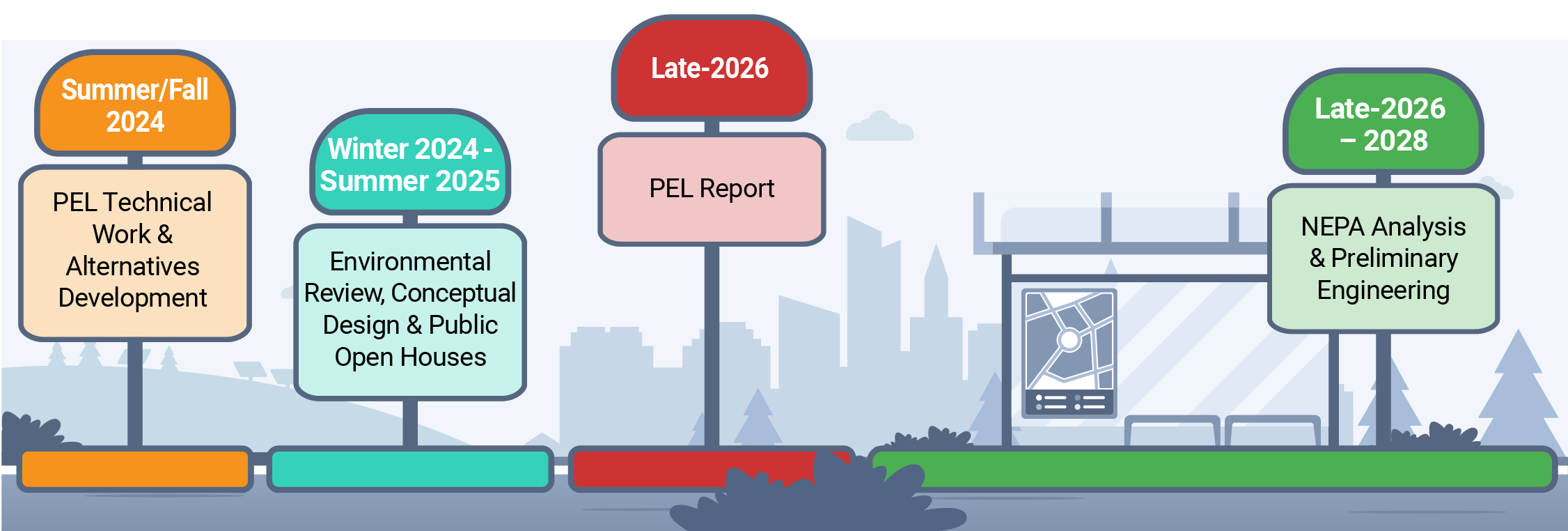
Timeline
Planning products and decisions made during this PEL Study will be used to complete a required National Environmental Policy Act (NEPA) analysis.
An exact construction timeline is not known at this time; however, to get to construction, a build alternative would need to be selected at the conclusion of the NEPA analysis (2028), then progress to design, followed by permitting and right-of-way acquisition. The entire process would likely not result in the start of construction activities until 2030 at the earliest.
Draft Service Goals
MTA is looking to select proposed improvements that meet the following service goals.

Deliver accessible, COST EFFECTIVE transit improvements that meet the mobility needs of the corridor’s activity centers

Contribute to reverse commuting by providing TRANSIT ACCESS to employment opportunities

Support TRANSIT ORIENTED redevelopment and enhance connectivity to Metrorail

Provide TRANSIT ALTERNATIVES connecting existing and planned development areas

IMPROVE ACCESSIBILITY to employment and services for transit-dependent populations

Provide an ENVIRONMENTALLY prudent and SUSTAINABLE transportation alternative

INCREASE THE CAPACITY of the transportation network in the corridor
Fact Sheet
Frequently Asked Questions (FAQs)
Project Background
What is SMRT and how does the current PEL Study relate to previous transit planning in the corridor?
SMRT stands for “Southern Maryland Rapid Transit” and refers to a potential project being studied to bring rapid transit service to Southern Maryland, connecting communities along the MD 5/US 301 corridor south of I-495 in Prince George’s County and the Waldorf-White Plains area in Charles County to the larger regional transit network at the Branch Avenue Metrorail Station. The need for transit in this rapidly growing corridor has been examined previously and the current PEL Study builds directly from work summarized in the 2017 SMRT Alternatives - Final Report.
This corridor has already been studied: Why is the MTA now conducting a Planning and Environment Linkages (PEL) Study for SMRT?
The most recent study of potential transit solutions for the corridor concluded in 2017. Major shifts in land use and travel patterns have occurred since then. The SMRT PEL Study is taking a fresh look at the existing conditions and future needs of the MD 5/US 301 SMRT corridor, while also moving the project forward. The PEL Study will evaluate previously identified and new potential transit solutions for the corridor based on current and planned development and growth in the area, comparing the potential benefits and impacts. Prior study information is available online at smrtmaryland.com. Planning products and decisions made during this PEL Study will inform future transportation efforts to deliver transit solutions for the area and could be used to accelerate the time it takes to conduct any required National Environmental Policy Act (NEPA) analysis, which is anticipated to begin in 2026.
What is being evaluated during the SMRT Planning and Environment Linkages Study (PEL Study)?
This PEL Study will consider wide array of rapid transit modes including Bus Rapid Transit (BRT), Light Rail Transit (LRT) and other transit alternatives such those that include dedicated transit-only right-of-way and mixed-traffic operations. The PEL Study will also examine the potential applicability of “Hybrid Rail” technology for the corridor transit alternatives running not only in dedicated transitways, but also mixed-traffic lanes will be evaluated. All alternatives evaluated will be supported by:
- engineering and environmental analyses;
- ridership forecasting;
- cost estimates;
- economic analysis;
- stakeholder coordination;
- public engagement; and
- other technical studies and coordination efforts.
How would a rapid transit option improve mobility in the SMRT corridor?
Providing additional travel choices along the SMRT corridor would provide an alternative to vehicle congestion along MD 5 and US 301 and provide faster and more reliable travel times. Rapid transit in this corridor and a connection to the Metrorail system will enhance access to major employment centers in the National Capital Region for corridor residents. It can also lead to economic development within the corridor near future stations to bring more jobs and services to the corridor residents. Potential alignment and station locations will incorporate enhancements for walking, biking, and local transit use within the corridor, to support future development plans and to link to Metrorail.
In addition, the PEL Study team is working closely with the Maryland State Highway Administration (SHA), Prince George’s County and Charles County to support roadway improvement projects, to maintain future right-of-way for a rapid transit guideway, and to encourage Transit Oriented Development. Also, transit technologies have the advantage of being more readily expanded to meet travel demands, by adding seats or adding trips, whereas opportunities for continued highway expansions in the area are likely to become increasingly expensive and disruptive.
Funding
Is the project funded?
The SMRT project development process has been funded with over $20 million in state and federal dollars to support initial project development. Current funding levels are expected to be sufficient for supporting the engineering and environmental analyses being conducted as part of the PEL process, and to support completion of the National Environmental Protection Act (NEPA) process that would follow. However, funding for design and construction of a potential build alternative has not yet been identified.
Transit Types
What kinds of rapid transit service are being considered?
The SMRT PEL Study is exploring a wide array of rapid transit options including Bus Rapid Transit (BRT), Light Rail Transit (LRT), and Hybrid Rail (YR). Descriptions and examples of these transit types are provided on the project website. Some of these approaches would require a separated or dedicated guideway, whereas others could operate adjacent to or within existing road rights of way with strategic expansions and improvements to support safe and efficient transit that may include mixed-traffic operations.
What kinds of right-of-way or transit guideways are being examined for the corridor and how could they affect traffic and properties?
Although the 2017 SMRT Study focused on providing a separate guideway for either BRT or LRT vehicles, the current SMRT PEL Study is considering a broader, more flexible application of technologies. The current study includes examining how transitways could be provided within or immediately adjacent to existing corridors and enhancing roadway function with a mix of dedicated lanes, transit signal priority, and queue jump treatments.
Another alternative is hybrid rail that has the potential of utilizing shared railroad track where available and using forms of propulsion other than the overhead electric systems used by LRT. Hybrid Rail may reduce property impacts due to its potential to utilize existing freight rail right-of-way and reduce the need for overhead wire infrastructure. Each alternative has different advantages and disadvantages which will be quantified and shared with the public to inform decision-making about how to balance transportation needs in the corridor while minimizing environmental and right-of-way impacts.
SMRT Service – Anticipated Frequency and Fares
How often would the SMRT buses/trains stop along the corridor?
The PEL Study includes the evaluation of multiple transit service operating plans for the SMRT corridor including service hours and frequency of service based on potential station locations, transit mode and alignment/speed. Based on current federal criteria, “rapid” transit service is defined to include service that operates at least every 15 minutes throughout every weekday or every 10 minutes during peak periods and no more than every 20 minutes at other times on weekdays. The definition also requires that weekend service also be provided, with service running at least every 30 minutes on weekends. The 2017 SMRT Study had identified 13 possible station areas to be served, and these are being reevaluated as part of this PEL study.
How much would it cost to ride SMRT and how would fares be collected?
General fare policies and average ticket prices will be developed later in the project development process. Compatibility with other transit systems payment options (cards, badges, apps, etc.) will be discussed with the future system operator, once determined.
Project Impacts
How will the project affect adjacent property owners and residents along the corridor? Will precautions be taken to protect residents from construction impacts and from the noise of transit operations?
The potential for noise and property impacts related to proposed SMRT Alignment Alternatives is being carefully examined as part of the SMRT PEL Study. The potential for noise and vibration will also be closely measured and monitored. The alignments are being developed to help minimize such impacts, while ensuring that the system could run safely and efficiently. Estimated impacts will be shared with the public and will serve as an important consideration for decision-makers as they evaluate alternatives.
If and when the SMRT project advances to construction, temporary lane closures and adjustments to travel patterns are likely. Additional coordination would then be expected to identify mitigation measures and to help ensure access to businesses and homes along the corridor.
How will the project affect the existing natural and cultural environment of the corridor? Will trees, waterways, parks, or other features that are important to my community be affected?
The SMRT PEL Study is developing a careful inventory of all the natural and cultural resources in the area that could be affected by the project’s construction. This work will include field visits across the corridor to fully document existing features and resources, and to recommend measures to avoid, minimize, or mitigate potential negative impacts.
Will introducing new transit service contribute to higher crime rates in the corridor?
By providing critical access to jobs, education, healthcare, and other vital services, transit can have a strong positive influence for the well-being and security of residents and businesses in adjacent communities. For many people in many communities, transit is a lifeline. It is true, however, that where criminal activity exists in a community, it can spill over into transit facilities. In MTA’s experience, these are generally isolated events and are not reflective of the safety and security of the system itself.
Transit agencies across the country have developed flexible strategies for addressing such concerns. MDOT MTA has consistently been ranked as one of the safest transit systems (among the top 13) in the country for nearly a decade. MDOT MTA Police have strong, collaborative relationships with our partner law enforcement agencies. Safety and security are continuously monitored, and agreements are in place to ensure agencies can respond effectively as needed, with appropriate security resources, incident response, and investigations. Transit personnel and infrastructure can also help improve security conditions in some areas, by the added access and oversight provided for transit security.
Agency Coordination
Who is involved in this PEL Study from government agencies?
This SMRT PEL study is a collaborative effort between FTA, MTA, Charles County, Prince George’s County, and other stakeholders who share a vision for improved transit in the corridor. The SMRT Intergovernmental Project Committee has been established as part of the Framework Agreement and includes representatives from MDOT, Charles County, and Prince George’s County. In addition, an Interagency Working Group (IAWG) to include regulatory resource agencies, and a Technical Advisory Working Group (TAWG) have been established to ensure the full range of technical expertise and stakeholder perspectives will be considered.
The draft Agency Coordination Plan is available for review and will be updated as the Study progresses.
Schedule
How long would it take to construct a transit system along the SMRT corridor?
A construction timeline has not been developed at this time. Prior to the design and construction phases, this PEL Study will need to be completed followed by the full NEPA Analysis and selection of a build alternative. It is anticipated that this PEL Study will be completed in spring 2026, followed immediately by the NEPA phase, which could be completed as early as 2028. After completion of NEPA, future project phases typically include final design and engineering, permitting, right-of-way acquisition, construction, and vehicle procurement. Testing and commissioning would also be required for any rail transit system before service could begin. At this time, funding has not been identified for these future phases.
Southern Maryland needs better transit solutions as soon as possible. What is being done to help address these immediate transit needs?
During the SMRT PEL process, many SMRT Stakeholders have emphasized that the immediate need for improved transit access in the corridor. Given the time and complexities often associated with implementing major rapid transit projects, there is strong interest in identifying transit solutions that could be delivered on a shorter timeline. The SMRT PEL Study has accordingly been expanded to explore transit service what could be provided with minimal expansions to the existing road right of way.
Public Engagement
How can I submit comments or ask questions about the PEL Study?
Your comments and suggestions are very important to us. You can provide ideas and opinions, or ask questions by visiting our project website: smrtmaryland.com, sending an email to:
Will there be an Open House for the PEL Study where I can go and talk to Study Team members in-person?
Three Open House events are scheduled for December 2025: One in Prince George’s County, one in Charles County, and one virtual (online) event. Materials shared in the initial round of Open Houses (held in June 2025) are posted to this site. In addition, MTA is holding several ‘pop-up’ engagement activities at key locations along the SMRT corridor to provide PEL Study information to the public and answer questions. Public engagement opportunities will be announced on the project website (smrtmaryland.com), so please check back often.